
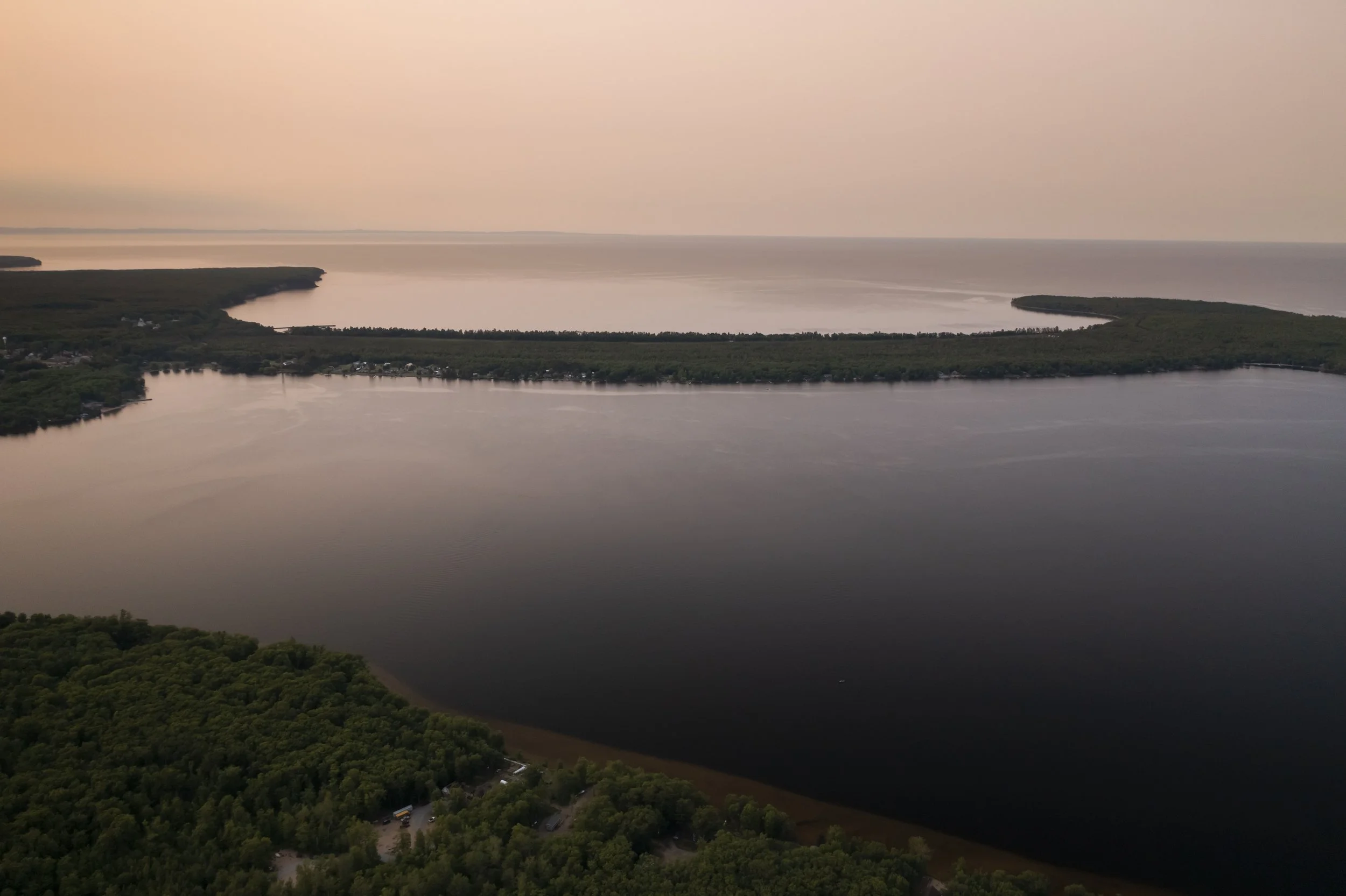
Destination Stewardship: Caring for Big Bay as a Place, Not Just Promoting It as a Destination
There is a moment on County Road 550 when the signal begins to fade.
The road narrows into the landscape. Forest gathers along both sides, Lake Superior waits somewhere
beyond the trees, and the noise of everyday life starts to loosen its grip. For many visitors, that quiet is part
of Big Bay’s appeal.
For those of us who live here, it is something more.
It is home.
That distinction sits at the heart of destination stewardship. The phrase may sound formal, but the idea is
practical: tourism should support the long-term well-being of a place, not simply bring more people to it.
Destination stewardship asks us to consider the whole picture. How do we welcome visitors while
protecting the land and water that draw them here? How do we support local businesses without
overwhelming local infrastructure? How do we encourage economic opportunity while preserving the
character of the community?
In Big Bay, these are not abstract questions. They shape the future of the place we share.
More Than Destination Marketing
Traditional tourism work often begins with promotion.
A community identifies its attractions, creates a message, and invites people to visit. That work has value.
Visitors support restaurants, lodging properties, guides, shops, events and other local services.
But promotion alone is incomplete.
A destination is not a product sitting on a shelf. It is a living place. It has residents, histories, working
landscapes, public services, seasonal pressures and natural limits.
Destination stewardship shifts the focus from simply attracting visitors to managing tourism responsibly. It
brings residents, businesses, local government, land managers, nonprofit organizations and recreational
groups into the same conversation.
The goal is not unlimited growth.
The goal is balance.
What Stewardship Means in Big Bay
Big Bay is surrounded by remarkable natural assets: Lake Superior, Lake Independence, forests, waterfalls,
trails and stretches of landscape that still feel genuinely remote. Outdoor recreation is central to the visitor
experience, but these places are also part of daily life for the people who live here.
Stewardship means recognizing that those assets are not endless.
A trail can erode. A roadside pullout can become congested. A waterfall can be loved beyond its capacity.
Litter, noise, unsafe parking and trespassing may appear minor in isolation, but over time they change the
experience of a place.
Responsible tourism begins by paying attention to those pressures before they become permanent
problems.
It can mean improving signs and visitor information so people know where to go and how to behave
responsibly. It can mean directing visitors toward appropriate access points, reinforcing Leave No Trace
practices and communicating that some beautiful places are also fragile places.
It also means making sure tourism provides real value to the community.
A healthy visitor economy should strengthen local businesses, create meaningful opportunities and
contribute to community improvements. It should not leave residents carrying all the costs while benefits
flow elsewhere.
The mission of the Big Bay Stewardship Council reflects this balance: protecting the unique nature of the
greater Big Bay area while encouraging community improvements and appropriately scaled economic
development.
The phrase appropriately scaled matters.
What works in a large resort community may not work here. Big Bay’s strength is not volume. It is character,
space, connection and a sense of discovery that cannot be mass-produced.
Stewardship Starts With Listening
No single organization can decide what Big Bay should become.
Destination stewardship only works when the people who live with its consequences have a voice in
shaping it. That includes full-time residents, seasonal residents, business owners, township officials, land
managers, nonprofit groups, recreational users and visitors who care about the area.
These groups will not always agree.
That is not a failure. It is part of the process.
Good stewardship creates room for honest conversation. It asks people to look beyond individual interests
and consider what will serve the community over time. It replaces quick reactions with shared responsibility.
Sometimes that work is visible: a new kiosk, a community event, a trail improvement or clearer wayfinding.
Sometimes it happens quietly around a table.
Both matter.
Big Bay’s stewardship work was built around this collaborative model, bringing together a broad cross
section of people connected to Powell Township. The community has also developed the Discover Big Bay
identity in partnership with regional tourism organizations, linking visitor promotion with local stewardship
goals.
The Visitor Has a Role, Too
Stewardship is not limited to organizations or public officials. Every visitor participates in it.
Where people spend money matters. How they park matters. Whether they stay on marked trails, carry out
their waste, respect private property and listen to local guidance matters.
Visitors do not need to experience Big Bay passively. They can help care for it.
That may be as simple as choosing a locally owned business, slowing down on rural roads or leaving a
shoreline cleaner than they found it. Small actions accumulate. Over time, they shape both the condition of
the landscape and the relationship between visitors and residents.
The best visitors are not merely consumers of a place.
They become temporary caretakers.
Protecting What Cannot Be Replaced
Big Bay has changed before.
Its history includes timber and other extractive industries that shaped both the economy and the land. Today, tourism and outdoor recreation offer new opportunities, but they also carry a familiar question: how do we benefit from a resource without exhausting it?
The answer begins with restraint.
Not every place needs more traffic. Not every hidden corner needs to be promoted. Not every opportunity must be developed simply because it can be.
Sometimes stewardship means building something useful. Sometimes it means improving what already exists. And sometimes it means leaving a place alone.
That judgment requires patience, local knowledge, and a willingness to think beyond the next season.
A Shared Promise
Destination stewardship is not a finished plan that sits on a shelf. It is an ongoing practice.
It asks us to notice what is changing, to respond thoughtfully and to remember that tourism is only
successful when the community and landscape remain healthy alongside it.
For Big Bay, stewardship means welcoming people without losing ourselves in the process.
It means supporting livelihoods while protecting the waters, forests and quiet spaces that give this place its
identity. It means understanding that residents and visitors are not standing on opposite sides of the issue.
Both depend on the same thing: a Big Bay that remains worth living in, working in and traveling to.
The road into town may feel like an escape from the wider world.
But caring for what waits at the end of that road is shared work.
And it begins with seeing Big Bay not simply as a destination, but as a place entrusted to all of us.

Big Bay Means Business
Big changes in Big Bay businesses!
2024 looks different around here, and we’re not talking about the snow (or lack thereof). Big Bay is on the precipice of change as long standing businesses sell to new owners, new businesses pop up, and existing businesses pivot to accommodate the needs of the community and its visitors. Visit our “Big Bay Businesses” tab on our website for more details about our locally owned businesses.
Huron Mountain Outfitters announced some updates to the shop including introduction of rentable e-bikes, along with kayaks, paddle boards, canoes and a fishing boat. Stop into the Outfitters from 7am-5pm everyday starting May 15th (opening day of walleye season!) for coffee by donation, live bait and friendly, familiar faces. If the door happens to be locked, feel free to ring the doorbell! Someone is usually in the building to assist you.
Across the street, in a stand alone log cabin sits Big Bay’s newest business: Huron Mountain Ice Cream. Expected to open Sunday, May 13th, the shop will offer fresh pressed waffle cones, hand scooped ice cream and other sweet treats. Pop on by between 2pm-9pm to satiate your sweet tooth this summer!
The Lumberjack Tavern, a well-loved local watering hole, is whipping up new creations in the kitchen, with plans to renovate the biergarten before summer. Stay tuned! This longstanding historic establishment now offers trivia on Mondays starting at 7pm and a Friday Fish Fry!
A few of our local lodging accommodations have undergone changes, as well! The Big Bay Motel, recently purchased by Jack and Meghan Cram, share that side of the 550 with a shop that holds their family name, Cram’s General Store. Stop by Cram’s for all your needs: gas, food, Big Bay merch and soft serve in the summertime! You can also drop in next door at the Hungry Hollow for a delicious meal everyday from 7am-2pm.
The Picture Bay Motel also had a change of ownership, and we look forward to the welcoming new owners to the Big Bay Business scene.
Other lodging options include Tranquility Haven, located on the beautiful shores of Lake Superior. Book one of the units at The Outpost and experience the beauty of the northwoods from a hip, cozy space in town.
Assisted Independence, a new business owned by Jim and Laura Mohrman, is located in the house next to The Big Bay Motel. This six bed assisted living has a primary goal of assisting elderly in living their best lives. A passion for owner Laura, who recognizes that independence can be a difficult loss for a person to grieve. Now fully staffed, Assisted Independence looks forward to taking more residents and growing their capacity.
Change is upon us, even in the quiet town of Big Bay, and as we embrace these transitions we also stay connected to what makes this area such a beautiful place to live and visit. If you choose to visit, please be mindful of the unique characteristics that make Big Bay what it is– our pristine lake front areas, trail systems and local parks are access points to observe wildlife habitats, stretches of untouched wilderness and the fragile landscapes that shape the great north. Visit our website to learn more about how the Big Bay Stewardship Council (BBSC) works to protect and celebrate this area and consider a BBSC membership or donation to support our efforts!
Are you a business in Big Bay looking to partner with the Big Bay Stewardship Council? Contact us at coordinator@bigbaystewardship.org! We’d love to chat with you!